
The 7-Day Reset
A holistic reflection on detoxing food, habits, noise, and the need for constant comfort
There are moments when the body asks for less.
Less stimulation. Less sugar. Less scrolling. Less noise. Less reaching for the nearest comfort simply because it is easy, familiar, or numbing.
“Sometimes the body does not need more. It needs less.”
That is what this reset was for.
My brothers and I decided to do the Core Restore 7-Day Kit together, but for me, the experience quickly became about more than food. It became a way to interrupt my patterns and return to a steadier internal rhythm. I wanted to simplify what I was consuming, yes, but I also wanted to look at the habits surrounding that consumption: the mindless snacking, the repetitive convenience foods, the digital overload, the background distractions, the small forms of self-abandonment that can gather quietly over time.
This was not about becoming a different person in seven days. It was about becoming more present inside my own life.
“The week was not about becoming someone new. It was about returning to myself.”
Why I Needed a Reset
I had been noticing the softer forms of drift.
Not dramatic dysfunction. Just the gradual pull toward convenience over intention. I do not eat out very often, but I do tend to fall into easy routines: air fryer meals, repetitive foods, low-effort comfort choices, snacks that fill space without offering much nourishment. Add in the digital layer of modern life, constant screens, social media reflexes, background shows humming through the evening, and it starts to feel like the system is running on default.
I wanted to pause that momentum.
Not to punish myself, but to see more clearly.
A reset, at its best, is not about control. It is about honesty.
An Important Note Before Starting
As always, I think it is really important to say that any kind of detox, fast, or major dietary reset should be approached with care. I would absolutely recommend consulting a doctor or qualified healthcare professional before taking on something more extreme, especially if you are on medications, have blood pressure concerns, blood sugar concerns, chronic health conditions, or anything that requires your body to stay closely regulated.
You never want to do something that significantly disrupts your biorhythm, routines, or physical baseline if you do not fully understand how it may affect you. If working with your doctor feels like the safest and most comfortable route, that is always a wise choice. A reset should support your wellbeing, not put you in a stressful or risky situation.
The Structure of the Week
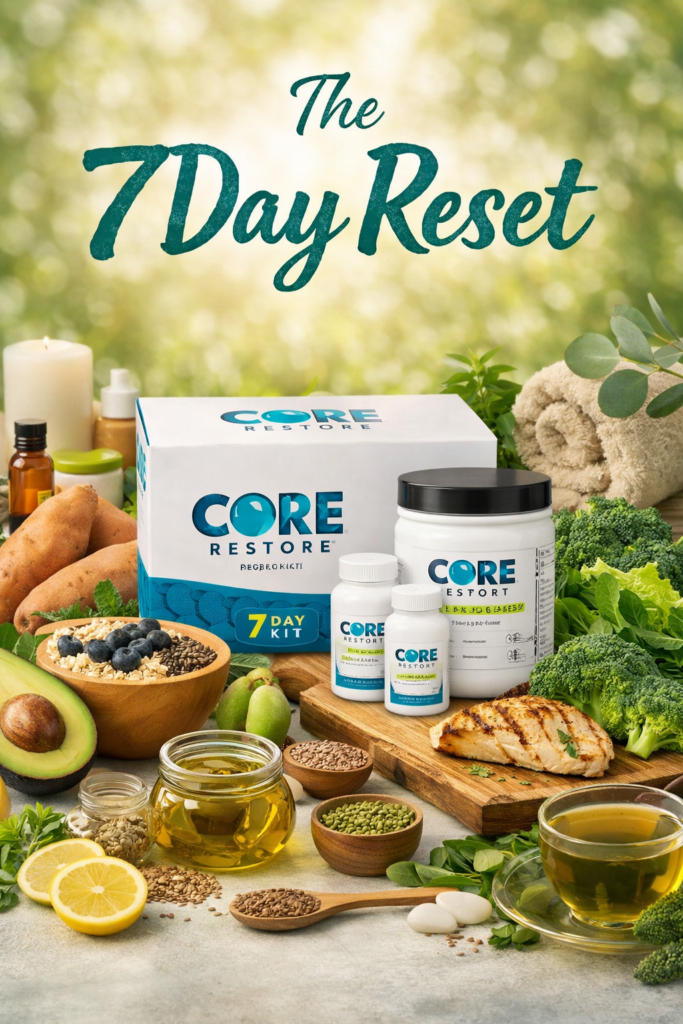
The Core Restore program begins with a fasting window, ideally 48 hours, though the plan offers shorter options depending on what feels manageable. I made it about 37 to 38 hours before I needed to eat something, which felt like the right point to listen to my body rather than push for the sake of pushing. I broke the fast gently with hummus and sweet potato, enough to stabilize without shocking the system.
From there, the week focused on eliminating:
- gluten
- dairy
- packaged foods
- refined sugar
- alcohol
- caffeine
- daily vitamins and non-essential extras
The meals themselves were simple and repetitive in the best possible way. I stuck to foods that felt grounding and realistic for me: cold-soaked oats, oat milk or coconut milk, avocados, sweet potatoes, organic chicken, turkey, broccoli, lentils, lots of water, and green tea beginning on day three.
I did not try to make the week impressive. I tried to make it honest.
Inside the Kit
One of the reasons the program felt supportive rather than random was that it included multiple components aimed at different detox pathways.
There was Core Support, a plant-based protein powder with fiber, minerals, antioxidant-rich vegetable extracts, and nutrients intended to support elimination and later phases of detoxification.
There was PhytoCore, which included botanicals and phytonutrients associated with liver support, such as artichoke, silymarin from milk thistle, garlic, dandelion root, inositol, and methionine.
And there was MitoCORE, a blend of vitamins, minerals, B vitamins, antioxidants, and nutrients designed to support energy production and the broader detox process.
A practical note, because these details matter: the plant-based chocolate protein was actually good. Not indulgent, not dessert-like, but good. It was not overly chalky, which made it far easier to incorporate daily. It tasted healthy in a clean, grounded way, and during a week like this, that kind of small mercy counts.
The Ritual That Held the Week Together
What transformed this experience from a simple cleanse into something more holistic was the daily ritual guide I used alongside it.
Each day had a rhythm.
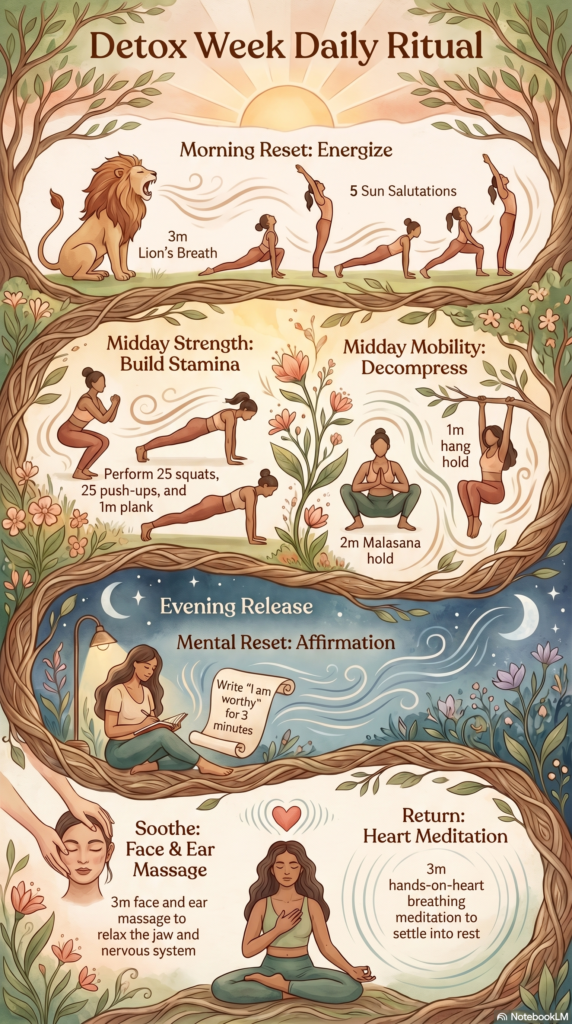
In the morning, I began with Lion’s Breath and Sun Salutations, a combination that brought both heat and clarity. At midday, the focus shifted into strength and decompression: squats, push-ups, plank, malasana, and a brief hang hold. In the evening, the energy softened into release through journaling, face and ear massage, and hands-on-heart breathing meditation.
That ritual structure gave the week an emotional architecture.
It reminded me that detox is not only about what you remove. It is also about what you restore.
“The ritual gave the reset a rhythm, and the rhythm gave it meaning.”
Breath.
Movement.
Circulation.
Stillness.
Self-contact.
Rest.
Without that layer, the detox might have felt like deprivation. With it, the week felt more like a conversation with my body.
The Hardest Part
The first two days were, unsurprisingly, the hardest.
No caffeine. No alcohol. No familiar little comforts. No casual reliance on the usual things that prop up the day. The physical adjustment was one part of it, but the mental component was just as revealing. It became obvious how often cravings are not about hunger at all. They are about habit. Reward. Soothing. Escape. Texture. Ritual. Delay. Emotional buffering.
Once those usual outlets are removed, what remains can feel startlingly unedited.
Fatigue. Restlessness. Irritation. Boredom. Compulsion.
“When the usual comforts fall away, what remains becomes easier to see.”
But clarity often arrives looking plain.
The discomfort showed me where I had been reaching automatically. That alone made the challenge worthwhile.
The Digital Detox, Imperfect but Necessary
I also tried to weave in a digital detox, though in modern life that phrase has edges.
I work with computers. I write. I create. I run projects that require online presence. Fully unplugging was not realistic. But reducing the unnecessary static was.
So I tried to step back from the reflexive forms of consumption: doom scrolling, checking apps without intention, using television as background atmosphere, filling every pause with input. I was only moderately successful, but even that made a difference. Some evenings, I traded screens for books that had been waiting patiently on my shelf, and that subtle swap felt like a quiet act of self-respect.
Not perfect. Still powerful.
What Shifted
By day four, the reset had begun to settle in.
My digestion felt better. My energy was more even. My mind felt cleaner, less crowded. I had also lost around four and a half pounds, but the more significant shift was the sense of internal spaciousness.
Less fog.
Less compulsion.
Less static.
“The real shift was not on the scale. It was in the static leaving my mind.”
By day five, I was absolutely ready for the experience to end, which felt honest too. But underneath that readiness was a growing sense that the reset had done what it needed to do. It had interrupted the loop. It had helped me notice where I was operating on autopilot. It had reminded me that I am still capable of changing the tone of my days with simple, intentional choices.
What I Am Bringing Back, and What I Am Not
One of the best parts of a reset is that it can sharpen your appreciation without turning life into a morality play.
I am not interested in permanent restriction. I am not trying to become someone who lives in a state of nutritional sainthood. I already know I will reintroduce things. I am excited about cottage cheese. I am excited about chocolate. I am still deeply loyal to cheese pizza.
But I want to bring those things back with more consciousness.
That is the actual gift.
Not discipline for its own sake. Not purity. Not aesthetic wellness theater. Just perspective.
The ability to pause before reaching. The ability to notice whether I am hungry or just overstimulated. The ability to ask whether a habit is comforting me or quietly dulling me. The ability to choose nourishment without needing the choice to be perfect.
The Real Lesson
If I could design the ideal version of this experience, it would happen in retreat mode somewhere beautiful and quiet, far from obligation, algorithm, and noise. But that is not the season I am in, and honestly, that is not the season most people are in.
Most of us are trying to recover our center while living ordinary life.
That may be what made this meaningful.
The reset did not happen in a vacuum. It happened inside work, routine, screens, responsibilities, temptations, and the everyday hum of modern stress. Which means its lesson is portable. It does not belong only to ideal conditions. It belongs to regular life.
And maybe that is where real wellness begins.
Not in escape, but in conscious return.
“Sometimes the deepest reset is simply interrupting what has become automatic.”
In Kindness Always,
The Floral Goose